
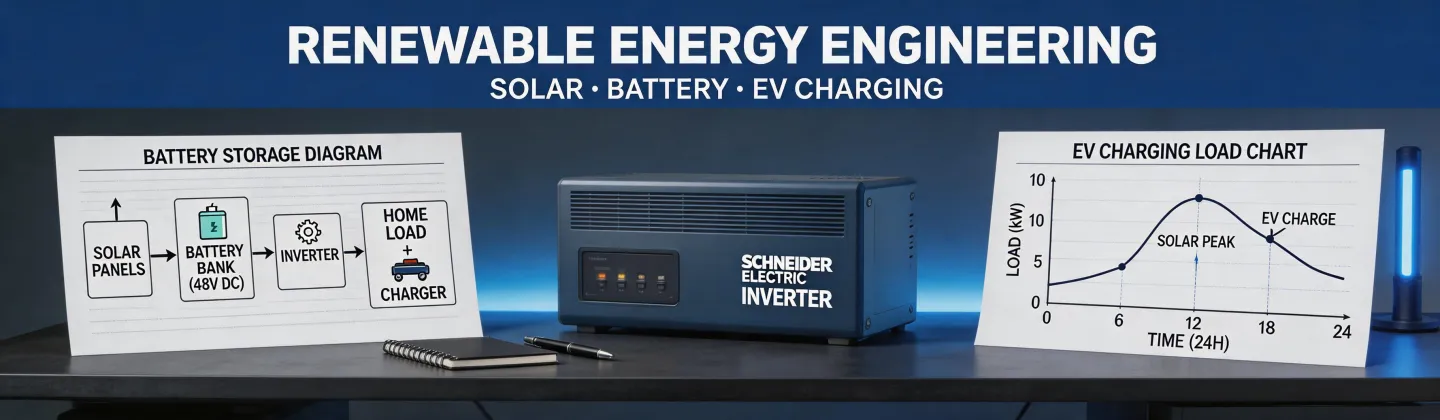
I’ve managed energy infrastructure procurement for a mid-sized manufacturing company for over six years. I’ve signed off on UPS replacements, battery bank expansions, and solar inverter integrations. I’ve also logged every single invoice in our system. And I’ve come to a firm conclusion: spending more upfront on reliable, integrated hardware—specifically from a brand like Schneider Electric—isn't a luxury. It’s the most cost-effective procurement decision you can make. Most buyers focus on the per-unit price of a UPS or a solar inverter and completely miss the hidden costs: unplanned downtime, compatibility troubleshooting, and rushed replacement cycles. That's where the real money gets burned.
The Trap of the Lower Sticker Price
When I audited our 2023 spending, I found a clear pattern. We had invested in a lower-cost hybrid inverter system for a new satellite office. The upfront savings were significant on paper. But over the next 18 months, we spent nearly double that saving on call-out fees, a replacement controller, and the man-hours spent re-configuring it with our existing Schneider Electric smart meters. The 'cheap' option resulted in a significant redo when compatibility failed.
That’s the classic rookie mistake, and I made it. Most buyers ask, 'What's the best price on a 10kW solar inverter?' The question they should ask is, 'What's the total cost of ownership over the next 10 years, including integration, support, and warranty claims?' I learned this lesson the hard way when a 'cost-effective' UPS failed to communicate with our building management system. The result? A $1,200 diagnostic fee and two days of lost production.
Why 'Preventive' is the Only Rational Procurement Strategy
This leads to my core belief: prevention is always cheaper than cure in energy infrastructure. The Schneider Electric net zero roadmap isn’t just a marketing slogan; for a procurement manager, it’s a planning framework. It allows me to predict upgrades 5-10 years out. The same logic applies to their hardware. A Schneider Electric UPS isn't just a box that provides backup power. It’s a system designed with network connectivity and industry-standard protocols. That foresight prevents the nightmare of trying to force a 'dumb' UPS to talk to a modern microgrid controller. A 5-minute verification of compatibility beats 5 days of correction. Our checklist now mandates that all new power equipment must be from a single ecosystem, minimizing communication failure risks.
I said 'lead time is critical.' Our operations team heard 'order three units next week.' Result: we didn't have time to properly spec the battery chemistry. We almost bought LiFePO4 battery cycles at 80% DoD rated for 3,000 cycles. While that's a solid battery, for our application with daily cycling, a different chemistry or a larger bank would have been cheaper per cycle. The surprise wasn’t the price of the battery. It was the cost of replacing it 3 years early because we didn't factor in our actual usage profile. That is a $4,200 mistake (if I remember correctly, though I might be misremembering the exact figure) baked into a single purchasing decision.
Facing the Obvious Objection
I know what you’re thinking: 'It’s easy to recommend premium brands when you aren't the one signing the purchase order for a tight-budget project.' And you’re right. I have been there. For a pilot project with a limited budget, I had to use a budget-friendly Luxpower hybrid inverter from a distributor. The wiring diagram was a nightmare, and I spent an entire weekend trying to figure out how to turn on the solar inverter because the manual was poorly translated. The setup time was triple what a comparable Schneider unit would have taken. We saved $800 on hardware but lost that in two days of my senior electrician's time. The 'free' support was inadequate. That experience forced me to build a TCO calculator.
So, I'm not saying you should never evaluate alternatives. I'm saying that a cheaper quote is often the beginning of a more expensive story. The true cost of the 'bargain' inverter wasn't the purchase price; it was the engineering time, the compatibility risk with our Schneider power distribution equipment, and the lack of a clear upgrade path for our net zero goals.
How We Changed Our Process
After tracking 50+ orders over 6 years in our procurement system, I found that 90% of our 'budget overruns' on energy projects came from one cause: scoping errors due to focusing on price instead of requirements. We now implement a mandatory compatibility checklist before any quote is requested. This one policy has cut our budget overruns on infrastructure projects by nearly 40%. The best part of systematizing this process? No more 3am worry sessions about whether a Schneider Electric UPS will communicate with a third-party solar inverter. The certainty alone is worth the premium.
Ultimately, aiming for Schneider Electric net zero targets or just wanting reliable backup power, the cheapest path is almost never the one with the lowest invoice. It’s the one that avoids the rework, the downtime, and the compatibility nightmares. It’s the path of prevention. I’ve got six years of data to prove it.

Jane Smith
I’m Jane Smith, a senior content writer with over 15 years of experience in the packaging and printing industry. I specialize in writing about the latest trends, technologies, and best practices in packaging design, sustainability, and printing techniques. My goal is to help businesses understand complex printing processes and design solutions that enhance both product packaging and brand visibility.