Brand Logo
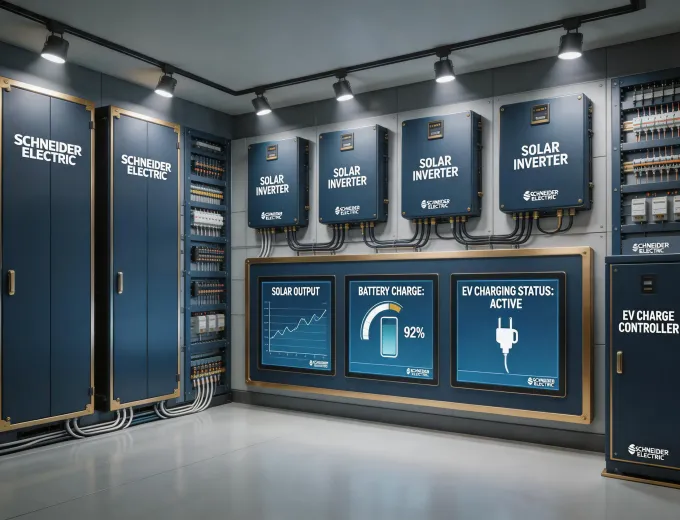
Renewable energy control room and storage equipment
Storage · BOS · Inverters · EV Charging

Schneider Electric renewable energy systems for engineered power continuity

Schneider Electric helps EPCs, energy directors, and asset owners align battery energy storage, solar inverters, UPS backup, disconnect switching, smart meters, and EV charging infrastructure before procurement locks the project scope.

Grouped Specification View

Electrical requirements organized by subsystem

Use this matrix as a practical starting point for RFQ discussions, tender review, and compatibility checks across storage, BOS, conversion, and charging equipment.

Battery Energy Storage and UPS Interface

Usable capacity planning
Residential, commercial, and utility BESS projects should separate nominal kWh, usable kWh, reserve margin, and critical load priority.
Chemistry and cycle profile
LFP systems are typically evaluated for cycle life, thermal management, BMS communication, EoL capacity, and service access.
Backup continuity
UPS and APC battery backup requirements need runtime, transfer behavior, maintenance bypass, monitoring, and replacement schedule review.

Solar Conversion and BOS Protection

Inverter class
Solar inverter, hybrid inverter, and microgrid designs depend on MPPT voltage window, CEC efficiency, THD, firmware access, and grid code region.
Switching equipment
AC disconnect, DC disconnect, surge protector, busbar, transformer, combiner box, and smart meter selection must match site voltage and enclosure exposure.
Documentation packet
Datasheets, wiring diagrams, installation manuals, commissioning records, and replacement equipment references should be gathered before release.

EV Charging and Monitoring Expansion

Load profile
Depot, workplace, and public EV charging projects require transformer capacity, demand management, communications, metering, and future charger count assumptions.
Monitoring stack
Energy monitors, smart meters, alarms, firmware status, and portal access create the evidence trail needed by O&M teams and asset owners.
Field support
Commissioning checklists, spares planning, and troubleshooting routes reduce site visits when storage, charging, and PV assets share infrastructure.
Authority Expert Format

Six engineering controls for renewable energy equipment selection

01

Grid-code vocabulary

UL 1741 SA, IEEE 1547, IEC 62109, CE, and regional approval language are kept visible during early scope review.

02

Storage interface clarity

Battery cabinets, UPS systems, hybrid inverters, and load panels are discussed as connected electrical assets.

03

BOS coordination

Disconnect switches, surge protection, smart meters, busbars, and combiner boxes are aligned with site voltage and environment.

04

EV charging readiness

Charger count, feeder limits, transformer capacity, metering, and future fleet expansion are captured before equipment release.

05

O&M evidence

Installation notes, firmware access, alarm logic, and spare-part planning help operators protect long-term fleet availability.

06

Procurement traceability

Every recommendation can be tied back to project parameters, compliance requirements, and lifecycle maintenance assumptions.

100+global energy and infrastructure markets served
5renewable power domains in one equipment scope
IECstandards language for procurement documents
24htarget response window for structured RFQs
Technical FAQ

Questions specification teams ask before shortlisting Schneider Electric

Yes. Critical load backup, battery energy storage, UPS replacement equipment, transfer behavior, and monitoring should be reviewed together when the site expects ride-through or resilience functions.

Share the single-line diagram, site voltage, MPPT window, enclosure location, disconnect duty, surge exposure, grid code region, and preferred monitoring architecture.

Charging equipment is reviewed as part of the electrical infrastructure, including load management, transformer capacity, metering, upstream protection, and future fleet expansion.

No. The site supports early selection and RFQ preparation. Final approval should use certified datasheets, installation instructions, and local engineering review.
Downloads

Compact documents for disciplined specification work

Engineering Desk

Send project parameters before the RFQ hardens

Share the power architecture, target region, equipment classes, and documentation gaps. Schneider Electric will help structure the inquiry around verifiable ratings and serviceable system boundaries.

  • Battery storage, UPS backup, and inverter interface review
  • Disconnect, surge protection, metering, and BOS coordination
  • EV charging load planning and monitoring evidence
Please enter your name.
Please enter a valid email.
Please describe your project requirement.
Consent is required before submission.